
Easy Words - Word Puzzle Games
EasybrainWord
4.83.46K Reviews
- Version
- 2.20.0
- Installs
- 1.00M
- Age Rating
- Teen
Screenshots
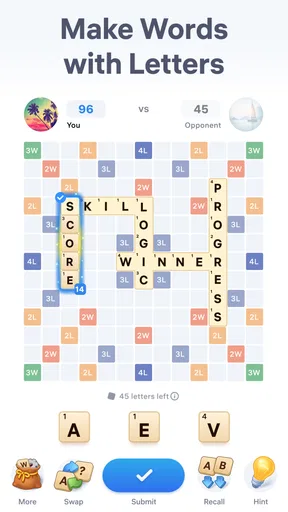
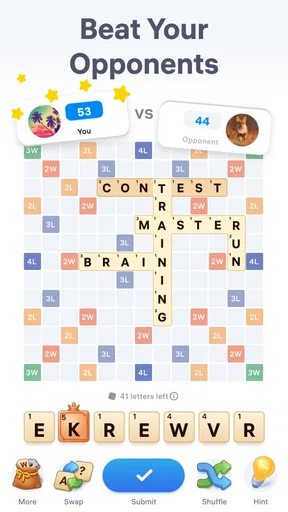
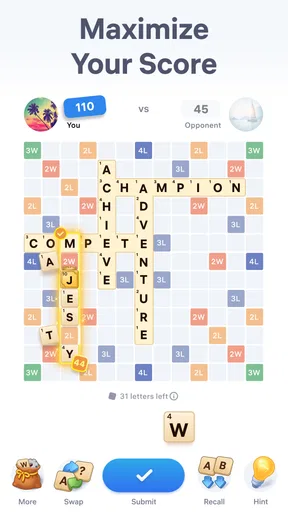
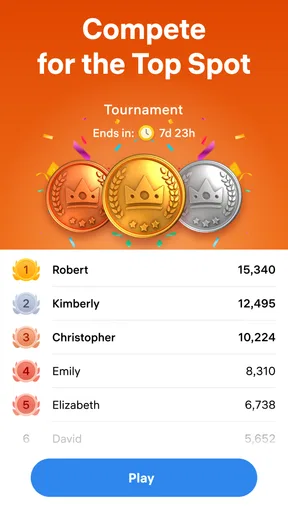
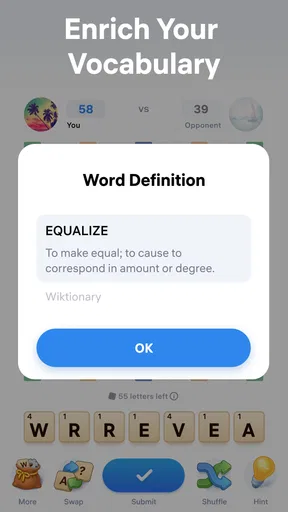
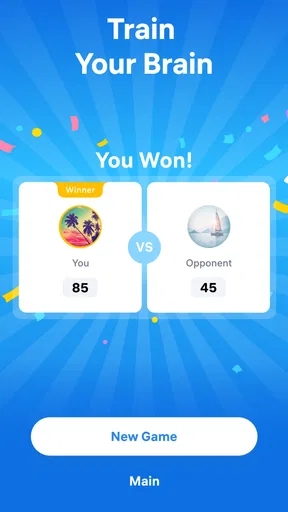
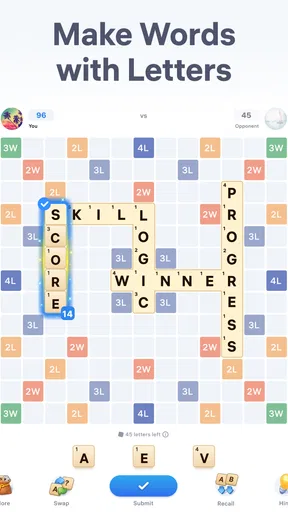
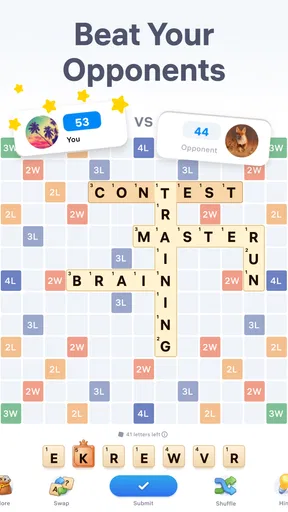
Our Review of Easy Words - Word Puzzle Games
 Analysis by Appyee
I approached Easy Words - Word Puzzle Games as a quick competitive word game rather than a traditional crossword collection. The basic idea is easy to understand: you work with letters, build words, and try to outplay another participant. That simplicity is the main attraction, but it also means the quality of each session depends heavily on how much you enjoy making fast decisions under pressure.
After spending time with it, I think it fits best into short breaks when I want something more active than a passive puzzle. It is free to download, made by Easybrain, and belongs firmly in the word-game category. Its audience is broad, although the Teen content rating is worth keeping in mind for families choosing games for younger players.
How the game feels when you start playing
The opening experience is refreshingly direct. There is no need to learn a complicated ruleset before understanding the point of a round. Letters are the raw material, words are the solution, and the opponent gives every decision a little more weight. I quickly found myself looking beyond the first obvious word and asking whether a shorter move might be useful now while preserving better letters for later.
That is where the game becomes more interesting than a simple vocabulary test. You are not only searching for valid words; you are also choosing when to spend useful letters, when to avoid a risky guess, and how much time to devote to finding something stronger. A player who knows many words has an advantage, but careful letter management matters too.
I would not describe the experience as a relaxed dictionary exercise. Even when the board or letter selection looks manageable, the presence of an opponent changes the mood. A move that would feel perfectly acceptable in a solo puzzle can seem wasteful when another player may answer with something more valuable. That competitive layer gives the game its identity.
A useful routine for short sessions
For everyday use, I found it easiest to treat each match as a small mental reset. A few minutes while waiting for an appointment, sitting on public transport, or taking a break from work is enough to make the game worthwhile. I would not open it expecting a long story campaign or a deep role-playing system. Its strength is the compact challenge: look, assess, form a word, and respond to what the other side is doing.
One practical habit helped me play more consistently: I stopped submitting the first acceptable word I noticed. Instead, I scan the available letters in three passes. First I look for an obvious longer word, then for unusual combinations, and finally for a safe fallback. This does not guarantee a win, but it reduces impulsive moves and makes the word search feel more deliberate.
That method is especially useful when I am tired. Rather than staring at the letters without a plan, I can work through them systematically. I also became more aware of common endings and beginnings, because spotting a familiar pattern can reveal a word faster than trying to rearrange every letter at random.
Where progress can feel satisfying
The rewarding part is not simply finding a word. It is recognizing improvement in the way I search. At first, I tended to focus on the longest-looking option and overlook smaller opportunities. With practice, I became better at checking alternate arrangements and judging whether a move was worth making immediately.
This makes the game suitable for players who enjoy learning through repetition. The progress is personal and practical: faster recognition, a wider working vocabulary, and better judgment during a contested round. It is less suitable for someone who needs a visible narrative reward after every session, because the appeal comes from the quality of the decisions rather than from a conventional adventure structure.
There is also a trade-off here. Word games can expose gaps in vocabulary very clearly. That can be motivating, but it can also make a poor round feel frustrating, particularly when a player knows there must be a better answer but cannot see it. I think the best mindset is to treat losses as information about search habits, not as a final judgment on language ability.
Spending, pressure, and competitive fairness
The game is free, but it includes in-app purchases priced at $14.99 per item. That is the main spending detail I would want a potential player to notice before installing. A free entry point makes it easy to try, while the listed purchase price means I would be careful about buying anything casually, especially if the game becomes part of a daily routine.
I prefer to separate the enjoyment of the core word challenge from the temptation to spend. The important question is whether I am still having fun making decisions with letters when I ignore optional purchases. For me, that is the right test: if the basic matches are engaging on their own, the game has value as a free download; if progress starts to feel dependent on spending, the experience becomes less attractive.
I cannot responsibly claim that purchasing creates an advantage, because that would require details that are not established here. What I can say is that the presence of a relatively high per-item price makes it sensible to pause before confirming a transaction. Players should know exactly what they are buying and whether it improves their experience enough to justify the cost.
For parents, the Teen rating and the purchase option deserve attention together. The rating is not a reason to avoid the game automatically, but it does mean I would not treat it as an unquestioned choice for children. On a shared device, purchase controls and supervision are sensible precautions regardless of how harmless a word puzzle may appear.
Does the pressure improve the game?
For me, competition improves the experience when I have enough time to think but not so much time that every move becomes effortless. It creates a useful tension between accuracy and speed. I feel more involved than I do in a completely solo word search, because every decision has an immediate social or competitive context.
That same pressure will not suit everyone. If you prefer solving at your own pace, a standard crossword, an anagram book, or a calm solo word app may be a better match. Those alternatives let you pause, revisit clues, and work without feeling that another player is waiting for your answer. This game is more appealing when the contest itself is part of the fun.
I also think the pressure can affect how fairly a player judges their own performance. A quick round may reward rapid pattern recognition, while a slower player may know equally good words but need more time to find them. I would therefore avoid using a single win or loss as proof that one person is “better” at words. The format tests vocabulary and decision speed together.
My view on fairness
The fairest way to approach the game is to focus on the choices visible during play rather than assume anything about hidden advantages. I found the central contest understandable: both sides are trying to form words and beat the other side. That clarity helps, because I can evaluate my own mistakes instead of feeling lost inside a complicated system.
Still, competitive word games naturally create uneven experiences. A player with a larger vocabulary may recognize possibilities sooner, while someone who is excellent at strategy may compensate by choosing safer moves. That is not necessarily a flaw; it is part of what makes the category interesting. The important distinction is whether you enjoy improving against that challenge or find the gap discouraging.
My advice is to play a few sessions before spending anything. Notice whether the basic loop remains enjoyable after the novelty fades, whether you feel pressured to buy, and whether the competitive format suits your temperament. If the answer to those questions is yes, the free entry point gives you a reasonable way to continue. If not, a purchase will not solve the underlying mismatch.
What I would want to know before installing
The public profile gives the game a strong reception, with a 4.8 average from around 135 thousand ratings. It has also passed one million installs, which suggests that it has reached a substantial audience. Those figures are useful signs of interest, but they do not replace personal testing. A highly rated word game can still be wrong for someone who dislikes timed or opponent-focused play.
The version I reviewed is 2.18.0, and the game requires Android 8.0 or later. That makes checking the operating system worthwhile before attempting installation on an older device. I would also keep enough attention available for the match itself; this is not the kind of app I open when I want to play entirely in the background.
The release date was October 16, 2023, so I see it as a relatively modern entry in a familiar genre rather than an old classic being maintained indefinitely. That matters mainly because expectations should remain realistic. The game’s appeal comes from its word-versus-word structure, not from pretending to be a large, content-heavy adventure.
Who should choose it
I would recommend it to someone who likes anagrams, quick vocabulary challenges, and the extra motivation of facing an opponent. It is particularly suitable for players who enjoy improving through repeated rounds and who do not mind that a good result may depend on finding the right word quickly.
It can also work well for a person who wants a small daily brain workout without committing to a long session. My most enjoyable use case was opening it during a short pause, playing with full attention, and then putting the phone away rather than letting the game consume the entire break. That keeps the challenge refreshing.
It is less suitable for players looking for a story, a large solo campaign, or a completely pressure-free puzzle. I would also hesitate to recommend it to anyone who is easily annoyed by uneven vocabulary contests or who wants absolute certainty that every competitive outcome is determined only by skill. In those cases, a solo crossword or an offline anagram game offers more control.
How it compares with familiar word-game alternatives
Compared with a crossword, this game feels less clue-driven and more immediate. A crossword rewards patient deduction across a larger structure, while this experience asks me to react to letters and the opponent’s presence. If I want a quiet Sunday puzzle, I would choose the crossword. If I want a brisk contest during a short break, this game is the better fit.
Compared with a solo anagram app, the competitive element gives each move more consequence. In a solo format, I can often experiment without worrying about another player’s response. Here, I have to balance exploration with efficiency. That makes the game more exciting, but also less forgiving when I am mentally tired.
Compared with a word board game, the appeal is the faster rhythm and smaller commitment. I do not need to organize a full group around a table to enjoy a contest. The trade-off is that the experience may feel less social in the traditional sense, because the focus remains on the letter challenge rather than conversation, negotiation, or a shared physical board.
My trust verdict after weighing the trade-offs
Easybrain’s game succeeds because it keeps the central idea readable while giving each letter choice some competitive weight. I like that I can understand the objective quickly, yet still find room to improve my scanning, vocabulary, and timing. The free download makes trying it straightforward, while the $14.99 per-item purchase price is a reason to keep spending deliberate rather than automatic.
My strongest recommendation is to judge it by the free play experience. Do you enjoy searching for better words even when no reward is attached to the move? Do you like the tension of answering an opponent rather than solving alone? If yes, the game has a clear place on your phone. If you prefer slow, clue-based solving or dislike performance pressure, the usual solo alternatives will probably serve you better.
The rating, audience size, and current version make it look established enough to deserve a fair trial, but I would not install it expecting a universal word-game replacement. Its identity is narrower and more focused: quick letter decisions with a competitive edge. That focus is its biggest strength and its clearest limitation.
In my experience, it is worth trying when I want a compact mental contest, especially during a spare moment when a full crossword would be too much. I would keep purchases separate from the decision to enjoy the game, supervise access on a family device because of the Teen rating, and move on without hesitation if the pressure outweighs the fun. For the right player, though, it offers a satisfying reason to look at ordinary letters a little more carefully.
Privacy and Permissions
See what permissions an app requests and how it handles your data.
- Photos/Media/Files
- read the contents of your USB storage, modify or delete the contents of your USB storage
- Storage
- read the contents of your USB storage, modify or delete the contents of your USB storage
- Wi-Fi connection information
- view Wi-Fi connections
- Other
- view network connections, full network access, prevent device from sleeping, Google Play license check
Verdict
Strengths of Easy Words - Word Puzzle Games
- Simple interface makes the game easy to start playing immediately.
- Short puzzles are convenient for quick breaks or casual sessions.
- Helpful hints can prevent players from getting stuck for too long.
- Word challenges support vocabulary practice and spelling awareness.
- Lightweight gameplay is suitable for a wide range of mobile devices.
Limitations of Easy Words - Word Puzzle Games
- Some puzzles may feel repetitive after extended play sessions.
- Difficulty can vary noticeably between consecutive levels.
- Hint systems may be limited unless players watch ads or spend currency.
- Frequent advertisements can interrupt the flow of casual gameplay.
- Players seeking competitive multiplayer features may find the experience limited.
Other Releases by Easybrain
View All
Art Puzzle - Puzzle Games
Puzzle4.8

Arrow Puzzle: Tap Puzzle Games
Puzzle4.8

Blockudoku®: Block Puzzle Game
Puzzle4.6

Sudoku.com - Sudoku Puzzle
Puzzle4.7
Similar Picks in This Category
View All
Word Search - Word Puzzle Game
Bluetile4.8

Word Search Quest - Puzzles
Blackout Lab4.8

CodyCross: Crossword Puzzles
Fanatee, Inc.4.7

Words of Wonders: Crossword
Fugo Games4.9

Wordscapes: Word puzzle game
PeopleFun4.7

Word Search Explorer
PlaySimple Games4.9
Frequently Asked Questions
What is Easy Words - Word Puzzle Games?
Easy Words - Word Puzzle Games is a casual word puzzle app designed for players who enjoy solving vocabulary-based challenges at a relaxed pace. It typically presents short word tasks, such as finding, arranging, or guessing letters and words. The simple format makes it suitable for quick sessions, whether you want a few minutes of entertainment or a longer brain-training activity.
Is Easy Words suitable for beginners and children?
The game is generally aimed at players who prefer accessible word puzzles rather than highly complicated crossword or trivia challenges. Its straightforward gameplay can be comfortable for beginners and casual players, while the vocabulary challenges may also help children practice spelling and word recognition. Parents should still check the app’s age rating, language level, advertisements, and privacy details before allowing younger users to play.
Does Easy Words - Word Puzzle Games require an internet connection?
Some features may work without a constant internet connection, allowing you to solve puzzles while traveling or when mobile data is unavailable. However, an internet connection may be needed for downloading new content, displaying advertisements, synchronizing progress, or accessing optional features. Availability can vary by version and device, so it is best to test offline play after installation rather than assuming every mode works without internet.
Is Easy Words - Word Puzzle Games free to download?
The app may be available as a free download, but free access does not always mean that every feature is included at no cost. Many casual puzzle games use advertisements, optional purchases, or paid upgrades to remove ads and unlock additional content. Before confirming a purchase, review the store listing and in-app purchase information, especially if the device is shared with children.
What should I know about privacy and permissions before installing it?
Before installing Easy Words - Word Puzzle Games, review the official Google Play or App Store listing for its current privacy disclosures and requested permissions. A simple word game should not normally need access to unrelated personal information, although advertising, analytics, notifications, or account features may request certain permissions. Also check the developer name, update history, ratings, and data-handling details before downloading.
Play our best games!


